

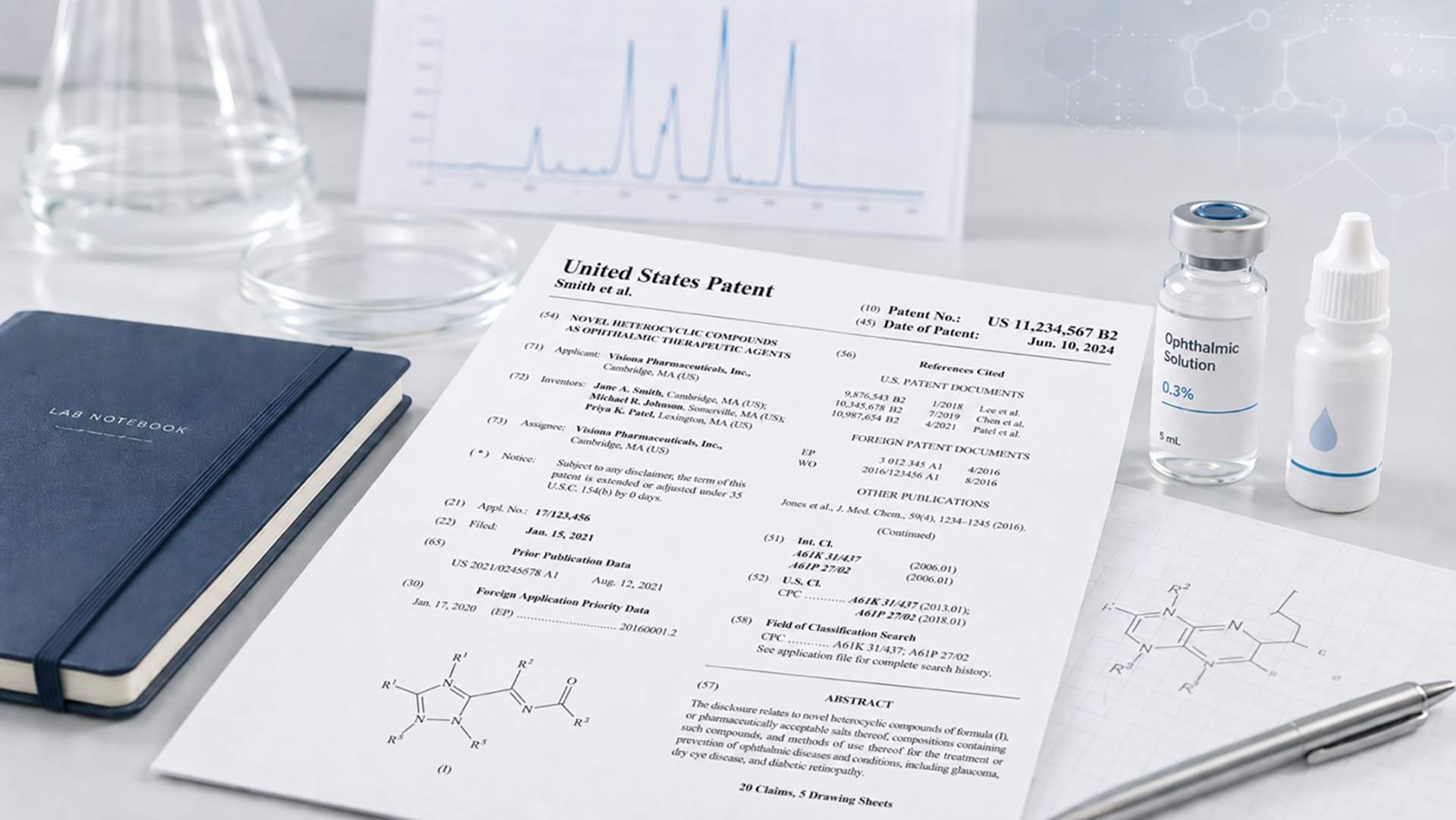
Have you ever read a novel—or watched a movie—that starts with the ending? That’s how you should read a patent: start at the end.
A common mistake (especially for scientists) is reading a patent like a scientific article—starting at the top with the abstract. We’re all busy. Papers can be long. We glance at the figures, skim the conclusion, and move on.
Patents are even longer—often 100+ pages—and even diligent patent attorneys don’t read every word line-by-line. So how do you read and understand a patent efficiently?

Bradford Sullivan, PhD
Vice-President & Co-Founder
Callan Pharma Services
Start with the claims. Start at the bottom.
The claims define what’s actually protected. Everything else is context
A simple ophthalmic example:
Imagine you find a patent whose abstract sounds broad: “Preservative-free ophthalmic formulations of API X with improved stability and tolerability.” If you stop there, you might assume it covers any preservative-free eye drop for API X.
Now go straight to Claim 1. It may actually require a specific combination of elements, such as:
- an ophthalmic solution comprising API X at 0.01–0.05%
- a specific excipient class (e.g., a nonionic surfactant or a chelating agent)
- pH and osmolality within defined ranges, and
- a preservative-free multidose container with a particular closure/valve feature
That Claim 1 is doing heavy lifting—and it may cover a much narrower slice of the “preservative-free” universe than the abstract suggests.
One more thing: treat issued patents and published patent applications differently. Applications are often published with broad “dream claims” that get narrowed during prosecution. But the published application is never updated—so to see what’s currently being pursued (or what was allowed), you need the prosecution history (the file wrapper).
Bottom-to-top checklist (how to read a patent fast):
- Start with the first independent claim (often Claim 1)
- Treat it like a checklist: what elements are required?
- Then skim the written description for definitions/examples that clarify claim terms.
- For published patent applications, check the prosecution history to see what’s currently being pursued (or what was allowed).