“One great advantage which inexperience confers on the would-be mountaineer is that he is not bogged down by tradition or precedence. To him all things appear simple, and he chooses straight forward solutions to the problems he faces.”
— Walt Unsworth, Everest: The Mountaineering History
The quotation from Walt Unsworth, written in the context of pathfinding, is equally applicable to drug formulation development. In pharma, teams can become so immersed in a problem that they lose the ability to see other ways of approaching it. Not because they lack expertise, but because they know the program so well, its history, its constraints, and its assumptions, that certain questions stop getting asked. That is often when an outside perspective becomes most valuable, especially when it is paired with the technical ability to test ideas and move the program forward.

Bradford Sullivan, PhD
Vice-President & Co-Founder
Callan Pharma Services
1. Being Close to the Problem Is Both a Strength and a Limitation
The people closest to a program usually know it best. They know the history, the failed experiments, the constraints, and why certain decisions were made.
But that same depth can make it harder to question the framing of the problem itself. Over time, certain assumptions stop getting challenged. For example, a team may keep optimizing around the same excipient system because it got the program this far, even when that same system is now creating downstream problems in stability, filtration, or delivery.
2. Stalled Progress Is Often a Sign That a New Angle Is Needed
Sometimes a team does not need more effort. It needs a different perspective.
That often shows up when the same debate keeps resurfacing, when repeated work has not created clarity, or when a formulation keeps getting optimized without really moving forward. A good example is filtration. A team may spend time screening different filters, when the more important variables are actually the filtration conditions: temperature, flow rate, flux, or the way the formulation was processed beforehand. The problem may not be the filter itself. It may be that the formulation or process is being approached the wrong way.
3. A Second Opinion Can Be Most Valuable Before There Is a Visible Problem
One of the best times to get a second opinion is before a program is clearly in trouble. A lead formulation may look good enough to enter the clinic, but that does not mean it will remain good enough as development continues.
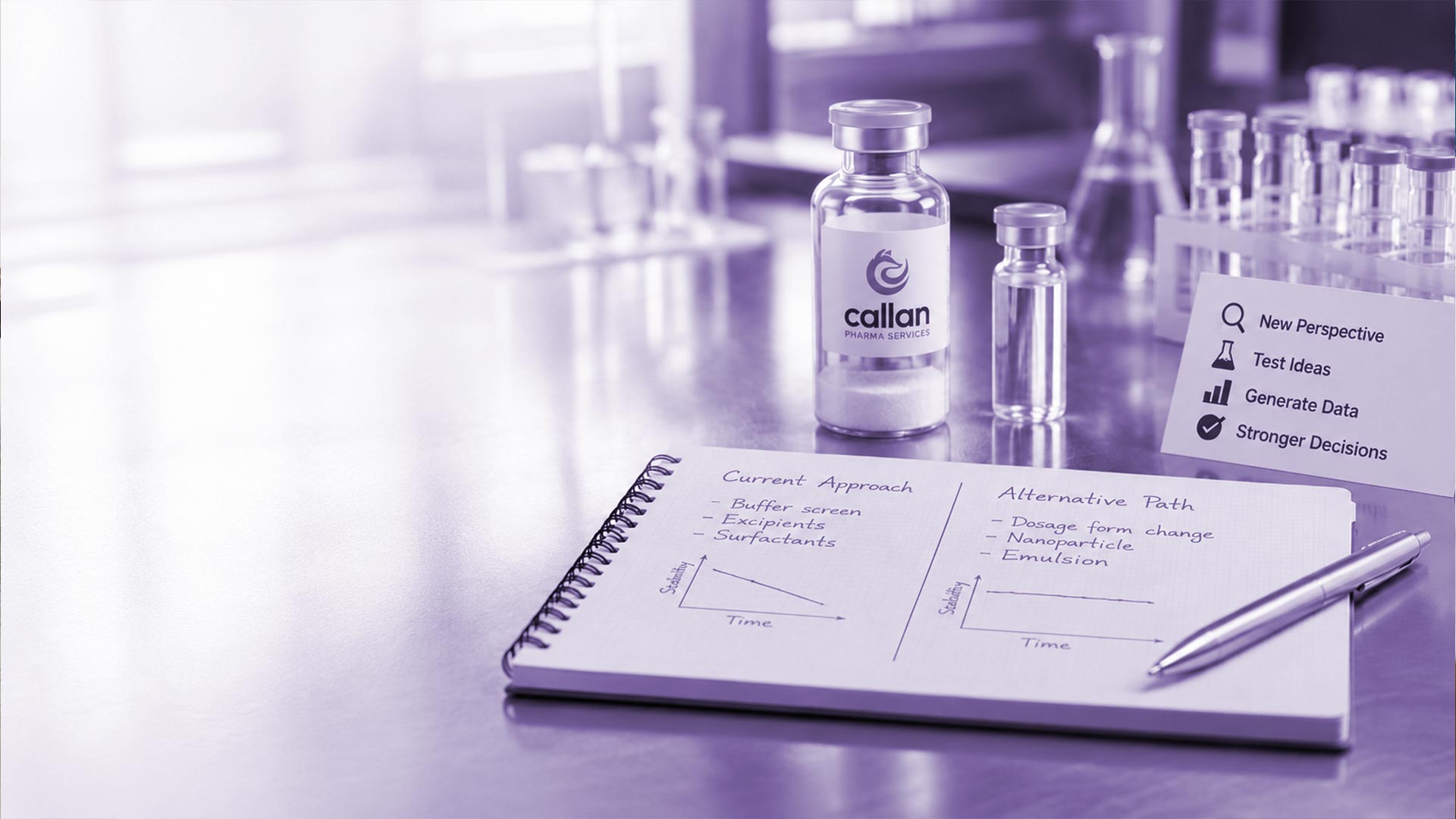
Unexpected issues can still emerge around stability, manufacturability, syringeability, scale-up, or broader CMC strategy, among others. For example, a team may keep trying to solve a stability problem by screening more buffers and excipients in solution, when the better answer is actually a dosage-form change, such as moving to a lyophilized powder. Without a backup formulation or reformulation path in mind, those issues can become much more disruptive than they needed to be.
4. The Best Outside Perspective Does More Than Offer Opinions
In pharma, it is one thing to suggest a different formulation strategy, process approach, or development path. It is much more valuable to pair that perspective with the ability to test ideas.
A second opinion is strongest when it can generate data, pressure-test assumptions, and help determine whether an alternative approach actually improves the program. A fresh set of eyes is useful. A fresh set of eyes with hands-on technical capability is much more useful.
5. A Second Opinion Can Help Define a Credible Backup Plan
One of the biggest advantages of outside perspective is that it forces a team to ask what happens if the current formulation stops being good enough. A program may still be moving forward, but that does not mean it is resilient.
For example, a team may keep optimizing a solvent-based or complexation lead because it is the formulation that got the program this far, when the smarter backup may be a different formulation archetype altogether, such as a nanoparticle or an emulsion. A good second opinion does not just ask whether the lead can be improved. It helps define what the next path looks like if it cannot.
The Strategic Takeaway
Do not wait until a program is obviously off track to ask whether there is another path. In pharma, the best time to seek a second opinion is often before the problem becomes urgent, while there is still room to test alternatives, define a backup strategy, and make better decisions with less pressure.
Just as importantly, a credible backup plan helps prepare the people around the program for the possibility of change. If leadership and investors already understand that there is a second path, moving off option one becomes a managed decision rather than a completely new and alarming idea. The goal of a second opinion is not to replace the people closest to the problem. It is to make the program more resilient before a problem forces the issue.
If a fresh set of eyes with hands-on bench capability would help your program, let’s talk.