

Introduction:
Nanotechnology in the Pharmaceutical Industry
Part 3 of 4: Lipid-based-Nanoparticles
One of the key enablers of nanotechnology’s future in drug delivery is the development of truly novel excipients—inactive ingredients that help overcome the limitations of traditional formulations. Unlike finished drug products (and, to some extent, active pharmaceutical ingredients), excipients are not approved through a standalone FDA pathway. Instead, both conventional and novel excipients are evaluated within the context of a specific marketing application (e.g., an NDA, sNDA, or BLA). This linkage has historically made sponsors hesitant to introduce new excipients, given the perceived regulatory risk. In response, FDA launched the Pilot Program for the Review of Innovation and Modernization of Excipients (PRIME), which includes the Novel Excipient Review Pilot Program—a mechanism to de-risk novel excipient development by allowing certain excipients to be reviewed outside of a single product application.
Nanotechnology in the Pharmaceutical Industry
Part 1: Polymeric Nanoparticles in Drug Delivery: Design, Benefits, and Emerging Trends
Part 4: Inorganic Nanoparticles – Core Materials, Clinical Examples, and Emerging Theranostics
Part 3: Lipid-Based Nanoparticles – Design Principles, Approved Products, and Next-Generation Technologies
The COVID-19 pandemic thrust lipid-based nanoparticles into the spotlight by enabling the rapid development and approval of lipid nanoparticle (LNP)–formulated mRNA vaccines for SARS-CoV-2. However, this class of formulation was already clinically validated before the COVID era—for example, ONPATTRO® (patisiran), the first FDA-approved siRNA therapy, was authorized in 2018 as an LNP-formulated siRNA for hereditary transthyretin-mediated amyloidosis. Long before and alongside these milestones, lipid-based systems have been an important class of nanocarriers for small molecules and nucleic acids—ranging from classic liposomes to newer ionizable lipid nanoparticles for siRNA and mRNA.
This is Part 3 of our 4-part series, where we focus on lipid-based nanoparticles—covering their structure, function, and use in approved products.
What Are Lipid-Based Nanoparticles?
Lipid-based nanoparticles are nanoscale drug carriers (typically ~10–300 nm in diameter) in which lipids are the primary structural component, arranged as bilayer vesicles with an aqueous core (liposomes), solid or semi-solid lipid matrices (solid lipid nanoparticles, nanostructured lipid carriers), dispersed oil phases in water stabilized by surfactants (nanoemulsions), or hybrid systems that combine lipids with other excipients (such as lipid–polymer hybrid nanoparticles).
Depending on their architecture and composition, these systems can encapsulate hydrophilic drugs or nucleic acids in an aqueous core or at the lipid–water interface, and sequester hydrophobic drugs within lipid bilayers or lipid cores. Because they are often complex mixtures with three or more excipients, formulators can adjust individual components to precisely tailor drug loading, storage stability, and pharmacokinetics for a wide range of APIs.
Common Types of Lipid-Based Nanoparticles
1. Liposomes
Liposomes are spherical vesicles composed of one or more lipid bilayers (most commonly phospholipids plus cholesterol) surrounding an aqueous core.
Examples of Lipids / Excipients
- Phospholipids (e.g., HSPC, DSPC, EPC)
- Cholesterol
- PEGylated phospholipids (e.g., DSPE-PEG2000, and DPPE-PEG2000)
Pros
- Able to carry both hydrophilic payloads (in the aqueous core) and hydrophobic payloads (in the bilayer)
- Proven clinical track record and a relatively well-understood regulatory precedent
- PEGylation and surface modification (e.g., targeting ligands) can extend circulation and modulate biodistribution
Drug Product Examples
- DOXIL® (liposomal doxorubicin): PEGylated liposomal formulation of doxorubicin that reduces cardiotoxicity and alters tissue distribution vs conventional doxorubicin. The ~80–100 nm liposomes are composed of HSPC, cholesterol, and a PEG–phospholipid with doxorubicin loaded into the aqueous core.
AmBisome® (liposomal amphotericin B): Liposomal amphotericin B formulation designed to improve tolerability vs conventional amphotericin B deoxycholate. The ~60–80 nm unilamellar liposomes are composed of HSPC, cholesterol, and DSPG, with amphotericin B embedded within the lipid bilayer.
2. Lipid Nanoparticles (LNPs) for Nucleic Acids
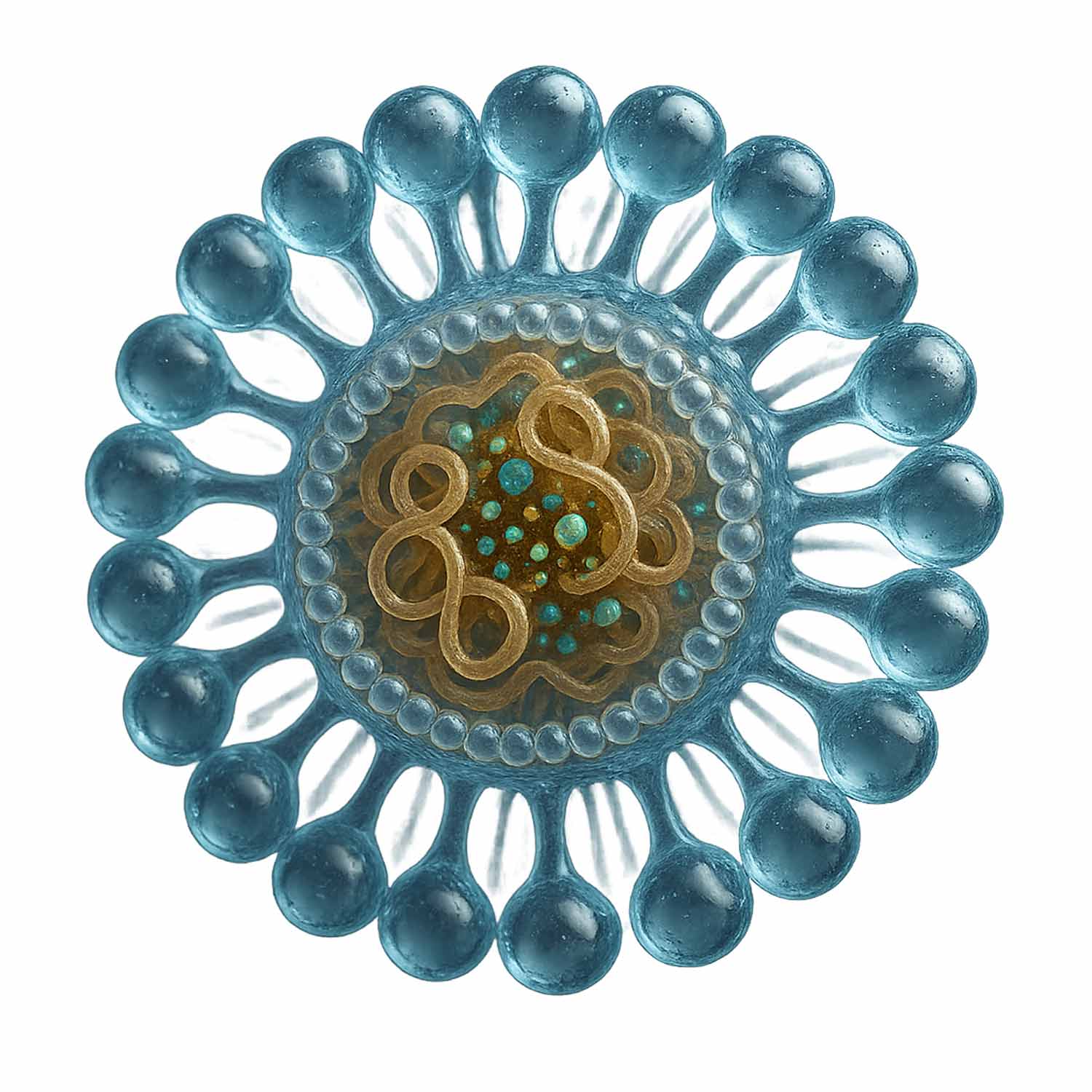
Lipid nanoparticles (LNPs) are ionizable lipid–based carriers, structurally similar to liposomes but optimized for siRNA and mRNA delivery by using ionizable cationic lipids instead of a simple phospholipid bilayer shell.
Typical Components
- Ionizable cationic lipid (e.g., DLin-MC3-DMA (MC3), ALC-0315, and SM-102)
- Phospholipid (e.g., DSPC, DOPE, and DOPC)
- Cholesterol
- PEG-lipids (DMG-PEG2000, and DSPE-PEG-2000)
Pros
- Ionizable cationic lipids bind nucleic acid cargo at low pH, become (mostly) neutral at physiological pH, which provides high encapsulation efficiency and in vivo delivery for siRNA/mRNA
- Facilitate endosomal escape via pH-activated ionizable lipids
- Established clinical precedent following approval of siRNA LNPs and mRNA vaccines
Drug Product Examples
- ONPATTRO® (patisiran): the first FDA-approved siRNA therapy, indicated for the treatment of polyneuropathy of hereditary transthyretin-mediated (hATTR) amyloidosis in adults, formulated as siRNA encapsulated in lipid nanoparticles composed of DLin-MC3-DMA (ionizable cationic lipid), DSPC (saturated phospholipid), cholesterol, and the PEG-lipid PEG2000-C-DMG, suspended in an aqueous phase.
Comirnaty® (tozinameran; Pfizer–BioNTech) and Spikevax® (elasomeran; Moderna) are mRNA vaccines indicated for the prevention of COVID-19 caused by SARS-CoV-2, each using nucleoside-modified mRNA encoding the viral spike protein encapsulated in PEGylated lipid nanoparticles. Comirnaty’s LNPs contain the ionizable lipid ALC-0315, DSPC, cholesterol, and the PEG-lipid ALC-0159, while Spikevax uses SM-102, DSPC, cholesterol, and PEG2000-DMG.
3. Solid Lipid Nanoparticles (SLNs) and Nanostructured Lipid Carriers (NLCs)
SLNs and NLCs are lipid-based nanoparticles in which the core is formed from a solid lipid (SLNs) or a mixture of solid and liquid lipids (NLCs), stabilized by surfactants to create a solid or semi-solid lipid matrix that can solubilize and protect lipophilic drugs.
Examples of Lipids / Excipients
- Solid lipids (for SLNs & NLCs): glyceryl behenate (Compritol® 888 ATO), glyceryl palmitostearate (Precirol® ATO 5), and stearic acid.
- Liquid lipids (for NLCs): medium-chain triglycerides (e.g., Miglyol® 812), oleic acid, and isopropyl myristate.
- Surfactants/ emulsifiers: polysorbate 80 (Tween® 80), poloxamer 188, and soy lecithin.
Pros
- Use of physiologically familiar lipids—appealing safety and biocompatibility profile
- Potential for controlled release via lipid crystallinity and matrix structure
- Route of administration flexibility, useful for oral, topical, and parenteral applications
Drug Product Examples
- Widely used in the cosmetic industry, SLN/NLCs have not shared the same clinical success as other lipid-based nanoparticles, and so far, none have been approved as drug products. Pharmaceutical translation is still early, with only a few topical or dermatologic examples—such as an oxiconazole nitrate SLN gel investigated clinically for tinea infections—rather than any widely approved injectable nanomedicines.
4. Emulsions (Lipid Emulsions and Nanoemulsions)
Emulsions are dispersed systems in which oil droplets (typically a triglyceride or mixed lipid oil phase) are stabilized in an aqueous continuous phase by surfactants and co-stabilizers; when droplet sizes are engineering into the nanometer range, they are often termed nanoemulsions.
Examples of Lipids / Excipients
- Oil phase: long-chain triglycerides (e.g., soybean oil), medium-chain triglycerides (MCTs), or mixed-oil systems (e.g., soybean/MCT/olive/fish oil blends).
- Surfactants/ emulsifiers: egg or soy phospholipids (e.g., egg lecithin), polysorbates (e.g., PS20 & PS80), poloxamers (e.g., P188 and P407).
- Aqueous phase/ stabilizers: osmolality adjusters (e.g., glycerin and dextrose), and buffers (e.g., citrate, phosphate).
Pros
- Versatile platform for BCS II and IV drugs—formulation for multiple routes including IV and oral lipid emulsions, in addition to nanoemulsions for mucosal or topical delivery.
- Manufacturing steps such as emulsification, homogenization, and microfluidization are well established, scalable, and supported by well-characterized process parameters.
- Favorable safety and regulatory precedent, as many oils, phospholipids, surfactants, and tonicity agents are compendial and used in marketed IV and oral products.
Drug Product Examples
- DIPRIVAN® (propofol injectable emulsion): an intravenous general anesthetic indicated for induction and maintenance of anesthesia and sedation. Propofol is dissolved in a soybean-oil phase and formulated as a sterile oil-in-water emulsion stabilized by egg lecithin, with glycerol for tonicity adjustment and water for injection as the continuous phase.
- RESTASIS® (cyclosporine ophthalmic emulsion): a topical ophthalmic emulsion indicated to increase tear production in patients with chronic dry eye disease. Cyclosporine is dissolved in a castor-oil–based oil phase and formulated as a white oil-in-water emulsion stabilized by polysorbate 80, with glycerin as an osmolality adjuster and a carbomer copolymer in the aqueous phase.
Key Advantages of Lipid-Based Nanoparticles
Across these different architectures, lipid-based nanoparticles can offer:
- Enhanced parenteral delivery of poorly soluble small molecules
- Enable injectable formulations of BCS II/IV drugs at clinically relevant concentrations, reducing reliance on harsh co-solvents or surfactants and helping to mitigate injection- or infusion-site irritation.
- Opportunities in ophthalmic delivery
- Can increase precorneal residence time, improve solubilization and corneal penetration of hydrophobic APIs, and support less frequent or lower-volume dosing compared with simple aqueous eye drops.
- Tunable pharmacokinetics and biodistribution
- Adjust lipid composition, PEG content, and particle size to modulate circulation half-life, RES uptake, and tissue exposure (e.g., tumor accumulation, liver targeting).
- Efficient intracellular delivery of nucleic acids
- Ionizable LNPs facilitate endosomal escape and cytosolic delivery of siRNA and mRNA, enabling gene-silencing and gene-expression therapies.
- Biocompatible and “known” excipient classes
- Use of phospholipids, cholesterol, and triglycerides with extensive pharmaceutical and parenteral nutrition precedent can simplify safety assessments relative to entirely novel materials.
Formulation Design Considerations & Challenges
Designing lipid-based nanoparticles—especially for injectable small molecules and ophthalmic delivery, with nucleic acids as a growing use case—requires balancing lipid composition, process, analytics, and route-specific constraints.
Lipid Selection and Composition
- Choose structural lipids (phospholipids, solid vs liquid lipids, cholesterol) and functional lipids (ionizable lipids, PEG-lipids, targeting lipids) compatible with parenteral/ophthalmic use.
- Manage oxidative and hydrolytic stability, particularly for unsaturated phospholipids and triglycerides.
- Favor injectable/ophthalmic-grade, compendial lipids to de-risk CMC and toxicology.
Drug Loading and Release
- Small molecules: control partitioning into bilayer vs core, avoid crystallization/leakage, and tune for rapid vs depot-like profiles (e.g., long-acting injectables, intravitreal depots).
- Nucleic acids: optimize ionizable lipid chemistry and N/P ratio to balance encapsulation efficiency, potency, and tolerability.
- Adjust lipid composition and phase state (solid vs liquid) plus stabilizers to dial in release kinetics.
Particle Size, Surface Properties, and Colloidal Stability
- Target size and PDI appropriate for IV/IM/SC injectables and for ocular comfort/visual clarity in topical or intravitreal products.
- Control zeta potential, PEG density, and surface corona to manage opsonization, RES clearance, muco/tear-film interactions, and aggregation.
- Ensure colloidal stability during storage and use (resistance to aggregation, fusion, Ostwald ripening, phase separation).
Route of Administration and Clinical Use Case
- Understand and respect route-specific limits:
- IV/IM/SC for systemic small molecules and nucleic acid therapies.
- Topical ophthalmic and intravitreal routes with tight constraints on pH, osmolality, viscosity, particulates, and preservatives.
- Define target profile: systemic vs local, rapid vs sustained, single vs chronic dosing, and acceptable local tolerability for lipids/surfactants.
Analytical and Manufacturing Complexity
- Use advanced analytics: size/PDI (DLS, NTA), zeta potential, encapsulation vs free drug, and lipid degradation/oxidation markers.
- Develop robust, scalable processes: microfluidization and high-pressure homogenization/emulsification.
Emerging Technology Spotlight: PEG Alternatives for Lipid Nanoparticles
The increased regulatory and clinical scrutiny of PEG-based excipients in injectable products—especially concerns about anti-PEG antibodies and PEG-related hypersensitivity—has created strong demand for PEG alternatives in lipid nanoparticles (LNPs). Sponsors still need the “stealth” and solubilization benefits of PEG but are increasingly exploring PEG-sparing or PEG-free LNPs with a more favorable long-term risk profile.
Poly(sarcosine) as a PEG Alternative
Poly(sarcosine) is a nonionic, hydrophilic polyamino acid built from the endogenous amino acid sarcosine (N-methyl glycine) and is emerging as a next-generation shielding polymer for drug delivery systems:
- Biodegradable and biocompatible – composed of amino acid–derived units that degrade to natural metabolites
- Low-immunogenic design – developed to avoid the anti-PEG antibody responses and ABC effects observed with some PEGylated systems.
- PEG-like solution behavior – high aqueous solubility, strong hydration, and effective steric stabilization of nanoparticles and conjugates.
Poly(sarcosine)–Lipids in Nucleic Acid LNPs
Companies such as Curapath are developing scalable poly(sarcosine)–lipid derivatives that serve as shielding lipids in nucleic acid LNPs:
- Drop-in stealth replacements for PEG-lipids (e.g., DMG-PEG) in existing LNP platforms
- Compatible with siRNA, mRNA, and other nucleic acids across standard ionizable-lipid/DSPC/cholesterol architectures.
- Target PEG-like circulation and colloidal stability while reducing dependence on PEG-based excipients and enabling PEG-sparing or PEG-free LNP designs.
What This Means for Sponsors
For sponsors working on LNP-based mRNA, siRNA, or gene-editing therapies, poly(sarcosine)-based shielding lipids offer:
- A practical PEG alternative for existing LNP platforms.
- A way to future-proof formulations against evolving expectations around PEG.
- An opportunity to build differentiated IP around PEG-free LNPs and novel shielding chemistries.