

In most service industries, your portfolio speaks for itself. In the pharma services world, your best work often stays hidden behind confidentiality agreements.
Prospective clients in most service industries can usually evaluate providers directly. An architect can point to buildings. A product design firm can show the products it helped create. A software company can point to products in the market. In the pharma industry, where the stakes are so high, this is usually not possible.
A pharma CRO’s most meaningful projects are likely to be highly confidential. You usually cannot publicly discuss the program, show the work itself, or talk about the problem you were brought in to solve. And the hardest problems—the ones where a CRO may have created the most value—are often the least shareable.

Kevin Sill, PhD
President & Co-Founder
Callan Pharma Services
So how do you evaluate a pharma CRO?
Of course, word of mouth is still enormously valuable if you have trusted people in the industry you can ask. But when you do not, you have to look more carefully at other signals that are harder to fake.
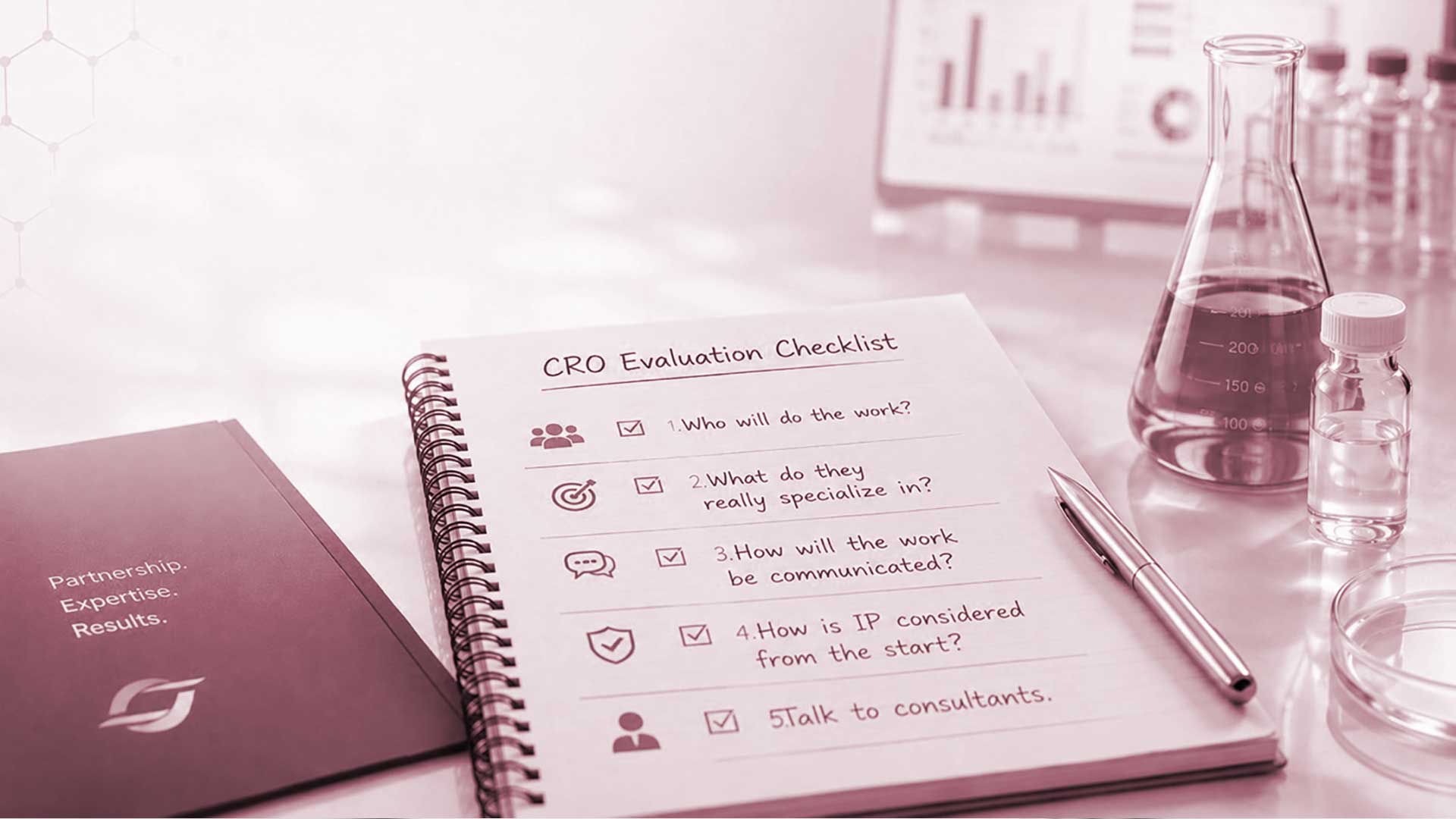
1. Ask who will actually do the work.
It is not uncommon to meet a senior business development person and a project lead during the sales process, only to learn later that the day-to-day work will be handled mostly by junior team members. Ask who will actually be assigned to the project, and ask to speak with them directly. It helps avoid playing telephone through layers of people who are not actually doing the work.
2. Ask what they really specialize in.
If a CRO says “yes” to everything, that should raise some concern. Pharma is inherently specialized. Very few groups can do everything, and even fewer can do everything well. A better sign is when a CRO is clear about its strengths and honest about what falls outside its scope.
3. Ask how the work will be communicated.
Time is money in pharma. Every month without progress is another month of burn. Speed matters, but formal reporting takes real time, and in some cases preparing a full report can consume as much effort as the lab work itself. There is a place for comprehensive reports, but if speed matters, it is worth discussing how data can be communicated quickly enough to support equally fast decisions.
4. Ask how IP is being considered from the start.
A good CRO should do more than recognize that IP matters. It should understand how IP considerations influence the way experiments are designed, how data is generated, and how problems are solved. The best CROs do not treat IP as a downstream issue. They build it into the strategy from the beginning.
5. Talk to consultants.
Consultants occupy an important space between sponsor companies and CROs. They cannot share confidential details, but over time they see a wide range of CROs, both strong and weak. That kind of pattern recognition matters. Their judgment is often one of the better sources of insight available in a business where so much of the work stays out of public view.
Final Thoughts
Confidentiality may limit what a CRO can show you, but it does not prevent you from seeing how it thinks and works. And in pharma, that is often the more important test anyway. The right partner is usually not the one with the best presentation, but the one that gives you confidence in how the work will actually get done.